

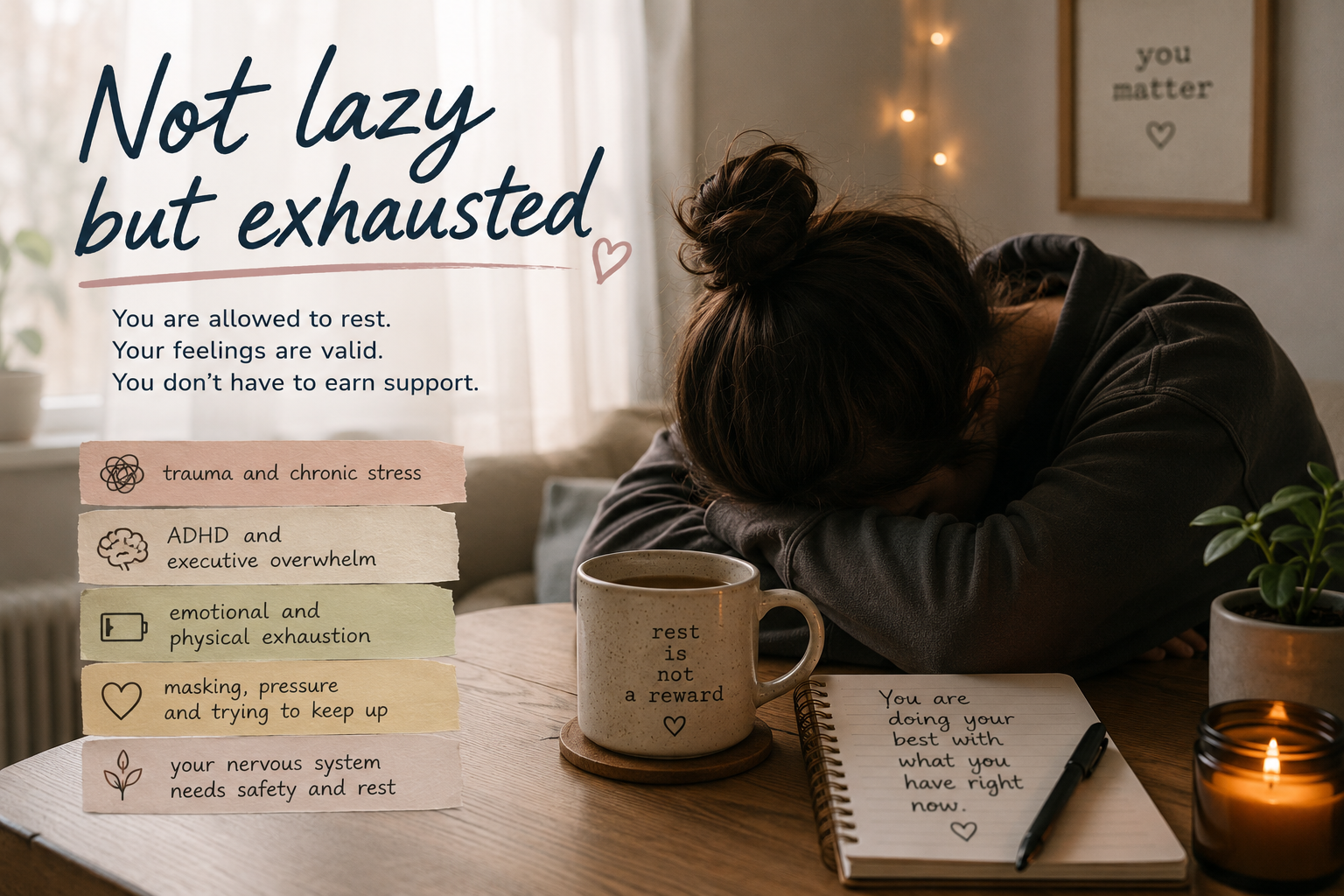
Not lazy but exhausted – “Why can everyone else do this so easily?”
Many people ask themselves this question quietly and repeatedly.
You look around and see others working, replying to messages, managing everyday life, staying organized, making plans, functioning.
Meanwhile, even simple things can sometimes feel overwhelming.
Getting out of bed.
Answering a message.
Taking care of yourself.
Making decisions.
Keeping up.
And after a while, many people begin to believe something painful:
“Maybe I’m just lazy.”
But what if you are not lazy at all?
What if you are simply exhausted?
Exhaustion Does Not Always Look Dramatic
Exhaustion is not always visible from the outside.
Some people continue functioning while internally feeling completely depleted.
Others become emotionally numb, disconnected, overwhelmed, or stuck in cycles of shutdown and guilt.
At the same time, many people push themselves far beyond their limits before realizing how overwhelmed they actually are.
Especially for people living with trauma, ADHD, depression, autism, anxiety, or chronic stress, exhaustion can become a constant background state.
You can also read more about support for trauma and ADHD.
Trauma, ADHD and Burnout Can Affect Everyday Life
When the nervous system spends long periods in survival mode, everyday tasks can start requiring enormous amounts of energy.
Things that may contribute to this include:
• chronic stress and emotional overload
• masking and constant self monitoring
• trauma related hypervigilance
• executive dysfunction and ADHD overwhelm
• emotional exhaustion from trying to “keep up”
• years of pressure, shame, or self criticism
As a result, rest may stop feeling restorative.
Even small tasks can begin to feel impossible.
Not Lazy but Exhausted: You May Have Learned to Ignore Your Limits
Many people who struggle with exhaustion have spent years trying to push through their needs.
They learned to survive by functioning.
By masking.
By overperforming.
By disconnecting from themselves.
Because of that, slowing down can sometimes feel uncomfortable or even unsafe.
Some people feel guilty when resting.
Others feel ashamed for struggling with things that seem easy for everyone else.
However, exhaustion is not a moral failure.
It is often a sign that the body and mind have been carrying too much for too long.
You Do Not Need to Earn Rest
Rest is not something you need to deserve.
For many people, feeling not lazy but exhausted is connected to long periods of stress, masking, trauma, or emotional overload.
You do not need to completely break down before your exhaustion becomes valid.
And you do not need to prove that you are suffering “enough” in order to receive support.
Sometimes, what people need most is not pressure or productivity advice.
Sometimes they need:
• understanding
• emotional safety
• nervous system regulation
• practical support
• permission to slow down
• a space where they do not need to constantly perform
Support Can Help You Feel Less Alone
I do not work as a therapist, and I do not try to replace therapy. Instead, I offer peer based support rooted in lived experience, emotional understanding, and everyday reality.
For many people, being able to talk openly without judgment already changes something important.
Because healing does not only happen through insight.
It also happens through feeling seen, safe, supported, and less alone.
You can learn more about my approach here:
Project Future Coaching
Maybe You Are Not Lazy but Exhausted
If this resonates with you, maybe your struggle is not a lack of discipline or motivation.
Maybe your nervous system has simply been overloaded for too long.
Maybe your exhaustion makes sense.
And maybe you deserve support, gentleness, and rest far more than you realize.
Additional mental health information can also be found at:
World Health Organization
If you are currently struggling and waiting for support, you can also read:
“Peer Based Support While Waiting for Therapy.”


 English
  Deutsch (Schweiz)
  Italiano
  Português
  Español
  Français
  Hrvatski
  Українська
  简体中文
简体中文
Leave a Reply